Most merchants who start hunting for Stape alternatives are not unhappy with Stape the product. They are unhappy with what Stape turned out to require: a server-side Google Tag Manager container someone has to build, debug, and babysit, plus a hosting bill that quietly climbs as traffic grows. Stape solved the hosting problem brilliantly. It never promised to solve the container problem, and for a Shopify store with no in-house analytics engineer, the container is the expensive part. This guide prices nine real alternatives against live 2026 pricing pages, explains the request-counting trap that wrecks most budget forecasts, and helps you pick the one that matches how technical your team actually is.
Quick answer: For Shopify merchants, the best Stape alternative is TagFly, which replaces both the hosting and the container work from $14.99 per month and bills by orders rather than by server requests, so the cost is forecastable. Technical teams who want to keep sGTM should look at Addingwell or Taggrs. High-volume stores needing order-level enrichment should evaluate Elevar.
What you’ll learn in this article:
- What Stape actually is, what it costs in 2026, and why merchants leave
- The request-counting trap that makes sGTM hosting quotes unreliable
- All 9 Stape alternatives compared in one table, with verified pricing
- A deep look at each option: who it fits, where it breaks down
- Stape vs TagFly head to head on 12-month total cost
- How to choose, and how to migrate without losing conversion data
- FAQ: free tiers, Shopify apps, GDPR, and switching costs
What is Stape, and why do merchants look for Stape alternatives?
Stape is a managed hosting platform for server-side Google Tag Manager containers. You still build the container, write the triggers, and configure every tag. Stape simply runs the server that container lives on, adds a first-party custom domain, and layers useful power-ups on top such as Cookie Keeper, Bot Detection, and the Custom Loader. It is genuinely the cheapest, most accessible way to get an sGTM container online, which is exactly why it became the default entry point into server-side tracking.
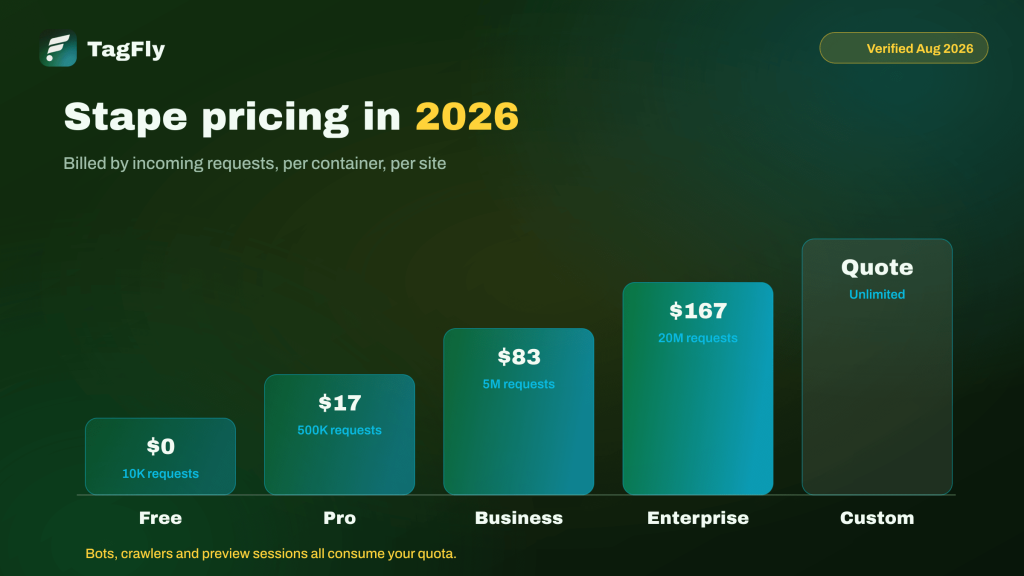
Here is Stape’s live pricing as of August 2026, taken directly from the Stape pricing page:
| Stape plan | Price | Request cap | Notable unlocks |
|---|---|---|---|
| Free | $0/mo | 10,000 | Custom Loader, Global CDN, Anonymizer |
| Pro | $17/mo (billed $200/yr) | 500,000 | 3-day logs, Cookie Keeper, Bot Detection, Shopify app |
| Business | $83/mo (billed $1,000/yr) | 5,000,000 | 10-day logs, Enricher, Multi-domain (20), File Proxy |
| Enterprise | $167/mo (billed $2,000/yr) | 20,000,000 | Account manager, 50 domains, log export to S3/GCS |
| Custom | Quote | Unlimited | Dedicated IP, private cluster, SSO, HIPAA BAA |
The five reasons merchants outgrow Stape
- You still have to build the container: Stape hosts your sGTM instance, it does not populate it. Every GA4 tag, every Meta CAPI tag, every trigger and variable is yours to configure and maintain.
- Debugging is on you: when purchase events stop firing after a theme update or a Shopify checkout change, there is no vendor who owns the fix. You own it.
- One container equals one site: Stape’s own FAQ confirms you need a separate container and a separate subscription per site. Multi-store merchants and agencies feel this immediately as a cost multiplier.
- The bill is metered, not flat: requests, not orders or sessions, drive your tier. Traffic spikes, bot crawls, and preview sessions all consume quota.
- Hitting the cap has teeth: per Stape’s plan tiers documentation, if auto-upgrade is off, your container simply stops serving traffic until the next billing period. Quota does not roll over. A Black Friday spike can silently kill your tracking on the highest-revenue day of the year.
The request-counting trap: why sGTM quotes are always wrong
This is the single most misunderstood part of pricing any Stape alternative, and skipping it is how merchants end up on a plan two tiers below what they need. Stape, Addingwell, and Taggrs all bill by incoming requests, which is not the same as GA4 events and definitely not the same as orders.
A request is every HTTP hit your server container receives. Per Stape’s own definition, that includes script loads such as gtm.js and gtag.js served through your container, not just tracking hits. Bots, crawlers, and your own preview and debug sessions all count. On the flip side, if one incoming event fans out to six destinations, it is still billed as one request, and outgoing calls are free.
⚠️ The practical consequence: your real request volume is usually a multiple of what your GA4 event count suggests, because GA4 filters out traffic your container still absorbs. Budget generously, or budget for the auto-upgrade you will eventually be forced to enable.
Self-hosting on Google Cloud Run has the same forecasting problem in a different costume. Analytics consultant Alexis Vantal priced the 2026 options in June 2026 and found that the widely quoted “$45 per month” Cloud Run figure covers a single instance, while Google recommends a minimum of two for resilience. That puts the realistic floor at roughly $90 per month before a single traffic spike, plus Cloud Logging charges past about one million requests, a load balancer for multi-region, and the engineering hours nobody puts in the spreadsheet.
The 9 best Stape alternatives in 2026, compared
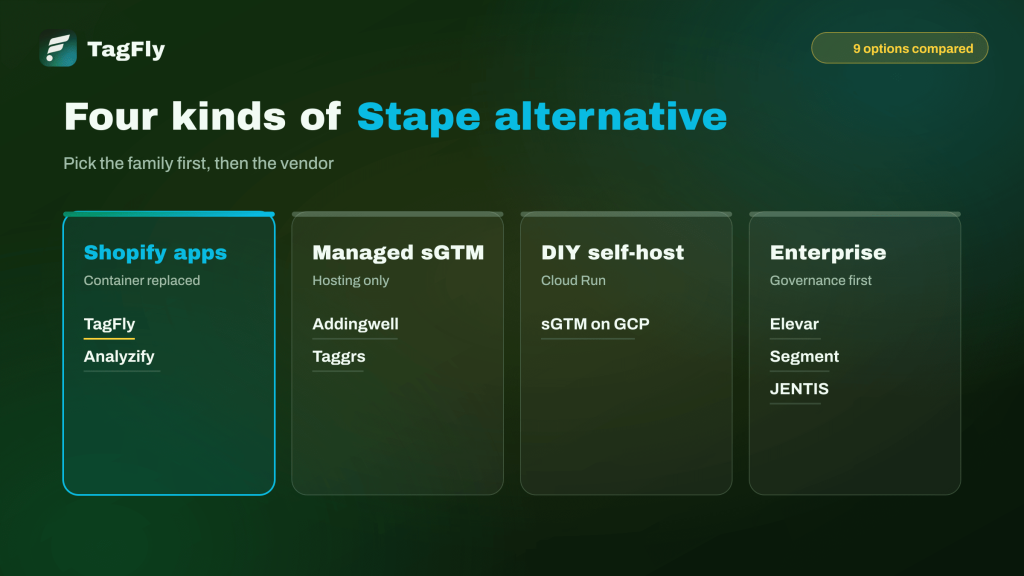
The nine options below split into four families: Shopify-native apps that replace the container entirely, managed sGTM hosts that compete with Stape directly, DIY self-hosting, and enterprise platforms. Prices verified against each vendor’s live pricing page in August 2026.
| Alternative | Category | Entry price (Aug 2026) | Best for |
|---|---|---|---|
| TagFly | Shopify app, no sGTM needed | Free, then $14.99/mo (500 orders) | Shopify merchants who want forecastable cost and zero container maintenance |
| Addingwell | Managed sGTM hosting | Free sandbox, then €90/mo (1M requests) | Technical teams needing EU hosting and strong debugging UI |
| Taggrs | Managed sGTM hosting | Free to 10k requests, then €20-25/mo | Small agencies and tinkerers wanting the closest Stape substitute |
| Self-hosted sGTM | DIY on Google Cloud Run | $90/mo compute + engineering time | Teams with in-house GCP skills and no vendor-lock tolerance |
| Elevar (Audiense Online) | Ecommerce tracking suite | $225/mo (2k orders, 2 destinations) | High-volume Shopify Plus stores with subscriptions or headless |
| Tracklution | No-code SaaS tracking | From €30/mo | Agencies and non-Shopify sites wanting a script-only install |
| Analyzify | Done-for-you setup | From $145/mo | Merchants who would rather pay a specialist than learn GTM |
| Segment | Customer data platform | Free dev tier, teams from $120/mo | Companies unifying web, app, and backend data with engineers on staff |
| JENTIS | Privacy-first enterprise | From €490/mo | EU enterprises where data governance is the buying criterion |
1. TagFly: the best Stape alternative for Shopify merchants
TagFly is the only option on this list that removes the sGTM container from the equation entirely while staying in Shopify-app price territory. It ships a prebuilt Google Tag Manager container plus native server-side tracking, so you connect a destination and TagFly handles the tags, the triggers, the deduplication, and the server. There is no Stape account, no Google Cloud project, and nothing to debug when a theme update lands.
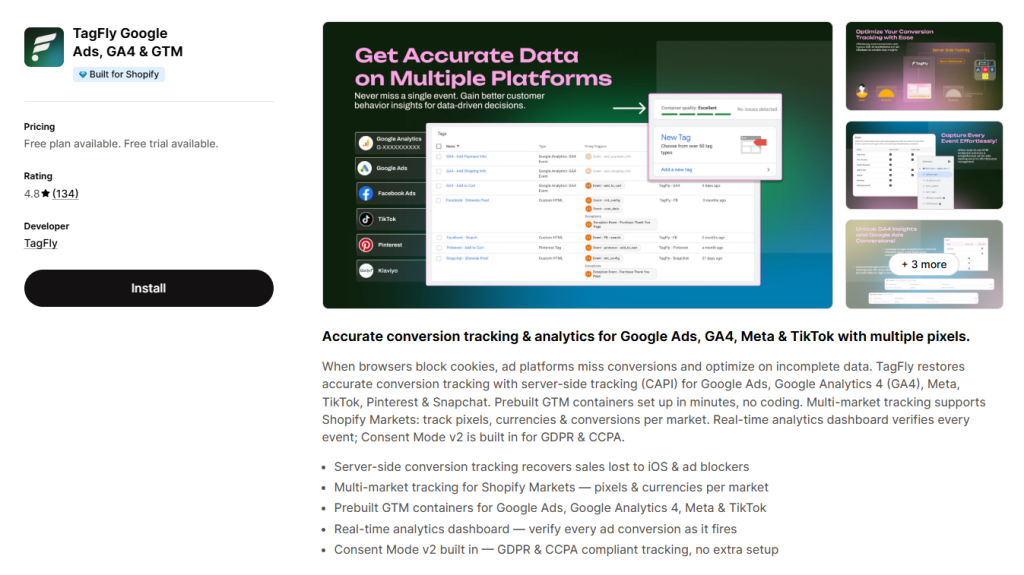
It sends data to nine destinations: GA4, Google Ads, Meta CAPI, TikTok, Pinterest, Snapchat, X, Klaviyo, and Microsoft Ads. Consent Mode v2 is native, event deduplication is automatic, and a real-time dashboard lets you confirm each event fired before you trust the numbers in Ads Manager. Across 200+ Shopify stores, TagFly’s own benchmarking shows server-side tracking recovers 30 to 40 percent of conversions that ad blockers and iOS restrictions otherwise erase.
Pricing, taken from the in-app billing screen in August 2026:
- Free, $0 forever: 10 orders per month, 1 tracking destination, 1 pixel. Includes server-side tracking, the prebuilt GTM container, real-time dashboard, Consent Mode v2, and the event builder.
- Basic, $14.99 per month: 500 orders per month, 3 tracking destinations, 1 pixel per destination. Adds the full channel breakdown report, full server-side event report, and Customer Analytics overview.
- Grow, $24.99 per month: 2,500 orders per month then $0.04 per additional order, all tracking destinations, multiple pixels. Adds full Customer Analytics, multi-market tracking, and high-priority support.
Yearly billing saves 15 percent, which puts Basic at $152.90 and Grow at $254.90 per year. Paid plans include a 7-day free trial, and the Shopify listing currently shows 4.8 stars across 136 reviews with a Built for Shopify badge.
⚠️ Note that TagFly meters too. The difference is what it meters: orders, not server requests. Orders are a number you already forecast, they map directly to revenue, and bots cannot inflate them. Requests are a number almost nobody can predict, because script loads, crawlers, and your own preview sessions all count. That is the substantive advantage, not a claim of unlimited usage.
Where TagFly is not the answer: if you need a fully custom container with bespoke server-side logic, BigQuery streaming from the container, or you run on WooCommerce, Magento, or a non-Shopify stack, TagFly is the wrong shape. It is deliberately opinionated about Shopify. A very high-volume store should also do the overage arithmetic: at 10,000 orders a month, Grow lands around $324 per month once the $0.04 overage is counted, which changes the comparison against Elevar’s Advanced tier.
💡 If you are paying Stape $17 per month plus a freelancer to keep the container healthy, TagFly’s Basic plan usually replaces both line items. See our guide to Google Tag Manager on Shopify for how the prebuilt container differs from a hand-built one.
2. Addingwell: managed sGTM hosting with EU data residency
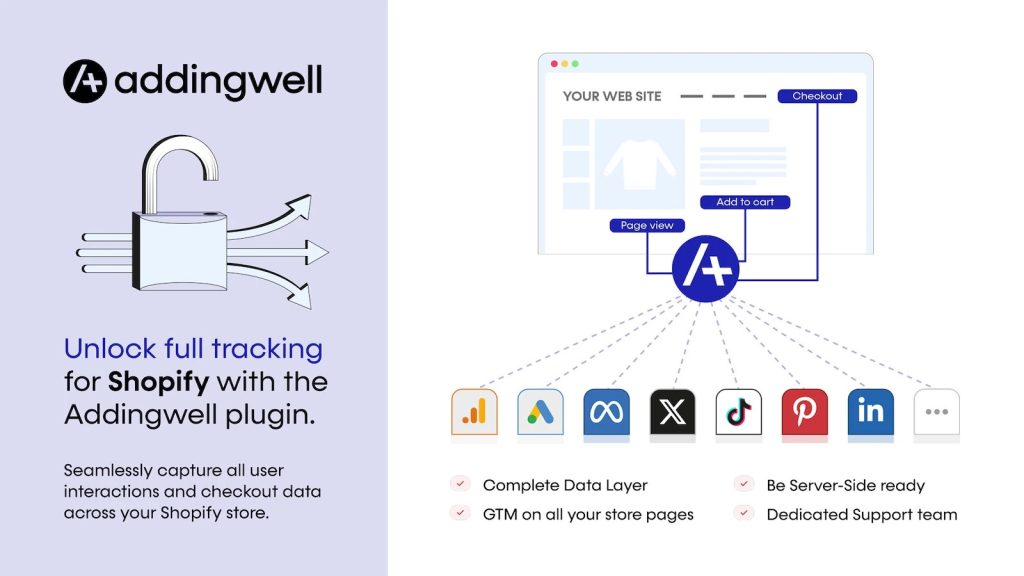
Addingwell is the most direct like-for-like competitor to Stape for teams that want to keep server-side GTM but improve the tooling around it. Part of the Didomi group, it offers EU and US data centers, a clean visual dashboard for logs and debugging, and managed infrastructure that removes the DevOps work without removing your control over tag logic.
Pricing: a free sandbox for testing, then usage-based tiers reported at roughly €90 per month for 2 million requests, €120 for 5 million, €210 for 12 million, and €360 to €1,190 for 25 to 100 million, with overage billed per 100k requests. Extra containers and domains carry their own add-on fees.
The trade-off: at low volume it is significantly more expensive than Stape Pro, and it still expects you to build and maintain the container. You are buying better tooling and EU residency, not less work.
3. Taggrs: the cheapest direct Stape substitute
Taggrs occupies almost exactly the same position as Stape: GDPR-compliant EU hosting, prebuilt GTM templates for Meta, GA4, Shopify, and WooCommerce, automated server creation, and an API for teams juggling multiple client containers. The free tier covers 10,000 requests per month, and paid plans start around €20 to €25.
Best for: small agencies and technically comfortable marketers who like the sGTM model and simply want a different vendor, better EU positioning, or a second option for redundancy.
The trade-off: switching from Stape to Taggrs solves a vendor problem, not a workload problem. Your container maintenance burden is identical the day after you migrate.
4. Self-hosted sGTM on Google Cloud Run: maximum control, real cost
Running your own container on Google’s server-side tagging infrastructure gives you total control: your cloud account, your logs, your BigQuery pipeline, zero vendor lock-in. For an organisation with an analytics engineer already on payroll, it can be the cheapest option at scale.
Real pricing: roughly $90 per month for the recommended two-instance minimum in “CPU always allocated” mode, plus Cloud Logging past about one million requests, plus a load balancer if you go multi-region, plus a custom domain, plus the engineering hours for image updates, monitoring, and debugging.
⚠️ The honest test: if nobody on your team can confidently answer “what happens when the sGTM stable image updates,” self-hosting will cost you more in lost conversion data than you save in hosting fees.
5. Elevar (now Audiense Online): enterprise-grade Shopify tracking
Elevar, which now sells as Audiense Online following its acquisition, is the heavyweight for Shopify and Shopify Plus stores that need order-level accuracy across subscriptions, multi-currency, and third-party checkouts. It combines a robust data layer, server-side event delivery, identity resolution, automatic event validation, and monitoring alerts.
Pricing, verified on the live pricing page: Core is $225 per month for up to 2,000 orders and 2 destinations. Advanced is $650 for 10,000 orders and 4 destinations. Premium is $1,250 for 30,000 orders and 10 destinations. Elite starts at $3,000 for 75,000 orders and 25 destinations. Additional destinations are $125 per month each, order overage runs $0.50 down to $0.04 per order depending on tier, and expert installation is a $1,000 one-time fee ($4,500 for headless).
The trade-off: Elevar is a genuinely excellent product priced for stores doing serious volume. For a merchant running four ad channels on 1,500 orders a month, the Core plan’s 2-destination cap means you are already paying $225 plus $250 in destination add-ons for what a Shopify app covers on a $24.99 plan.
6. Tracklution: no-code server-side tracking for any site
Tracklution is a plug-and-play SaaS platform aimed at advertisers and agencies rather than developers. You connect ad accounts, drop in one script, and events are processed server-side and forwarded to Google Ads, Meta, TikTok, LinkedIn, and others. It is EU-hosted, GDPR-focused, and priced from around €30 per month with a 14-day trial. The company publishes its own Stape alternatives comparison, which is worth reading for its DIY-versus-managed framing.
Best for: agencies managing many client sites across mixed platforms, or SaaS and lead-gen sites where a Shopify app is irrelevant.
The trade-off: for a Shopify-only merchant, a script-based generalist gives you less Shopify-specific depth (Markets, checkout events, order enrichment) than a native app, at roughly double the price.
7. Analyzify: done-for-you implementation
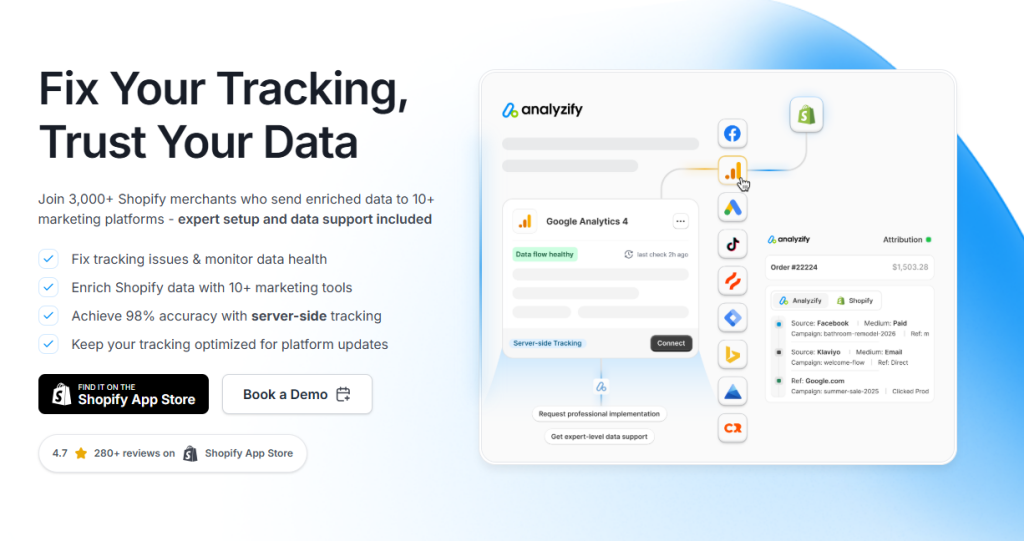
Analyzify sells the outcome rather than the tool. Their team implements GA4, Google Ads, Meta CAPI, and server-side tracking on your store and validates it, starting around $145 per month. If your blocker is knowledge rather than software, buying an expert is a rational move.
The trade-off: you are paying a services premium indefinitely for a setup that a purpose-built app configures automatically. Consider it a bridge, not a destination.
8. Segment: a CDP, not a tracking tool
Segment (part of Twilio) collects, unifies, and routes first-party data across 400+ integrations, including server-side event collection. It is the right answer when the real problem is that customer data lives in five disconnected systems, not that your Meta pixel is under-reporting. There is a free developer plan, team plans from roughly $120 per month, and enterprise pricing by quote.
The trade-off: Segment needs engineering resources to maintain pipelines, and pricing scales fast with event volume. It is over-scoped for conversion tracking alone.
9. JENTIS: privacy-first enterprise tracking
JENTIS combines server-side tag management with full data governance, raw-data access, and anonymisation designed for GDPR and ePrivacy compliance, with EU-resident infrastructure. Published plans start around €490 per month and onboarding typically involves a paid implementation project.
Best for: EU enterprises and public-sector organisations where a compliance officer, not a marketer, signs off on the tracking stack.
Stape vs TagFly: which actually costs less over 12 months?
This is the comparison most Shopify merchants are really running. The list prices look close. The total cost of ownership does not, because Stape’s number is hosting only.
| Factor | Stape | TagFly |
|---|---|---|
| What you get | sGTM container hosting only | Prebuilt container plus native server-side tracking |
| Billing model | Metered by incoming requests | Metered by orders |
| Can you forecast the bill? | Hard: bots, crawlers and script loads all count | Yes: orders are a number you already track |
| Entry price | $17/mo (500k requests) | $14.99/mo (500 orders), or $0 free |
| Next tier up | $83/mo at 5M requests | $24.99/mo at 2,500 orders, then $0.04/order |
| Setup effort | Build every tag, trigger, and variable yourself | Install, connect destinations, done in minutes |
| Multi-store | One container and one subscription per site | Per-store app install, Shopify Markets supported |
| If you exceed the cap | Container pauses, or auto-upgrades your bill | Tracking keeps running, $0.04 per extra order on Grow |
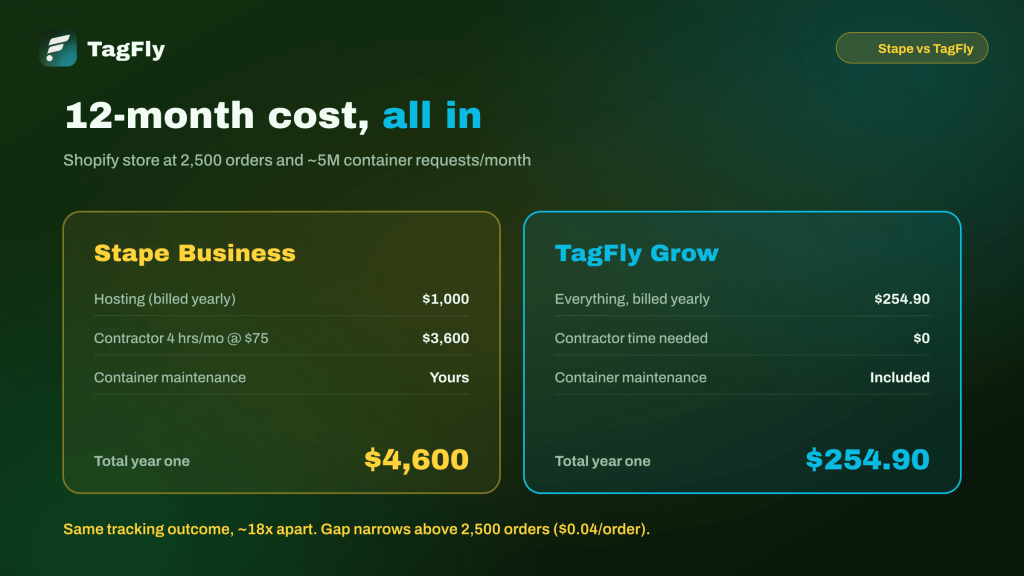
Run the arithmetic on a store doing 2,500 orders and roughly 5 million container requests a month across four ad channels. Stape Business is $1,000 billed yearly. Add even four hours a month of contractor time at $75 to keep the container healthy and you are at roughly $4,600 a year. TagFly Grow covers 2,500 orders and costs $254.90 billed yearly, maintenance included. Elevar Core at that order volume is $225 per month plus 500 overage orders at $0.50, or $5,700 a year.
That is roughly an 18x gap between Stape all-in and TagFly, and it holds because the contractor line item does not exist on the TagFly side. The honest caveat: the gap narrows as orders climb, since Grow charges $0.04 per order above 2,500. At 10,000 orders a month TagFly runs about $3,900 a year, still below Stape all-in and well below Elevar Advanced at $7,800, but no longer a rounding error. Do your own arithmetic at your own order volume rather than trusting the headline price.
How to choose the right Stape alternative
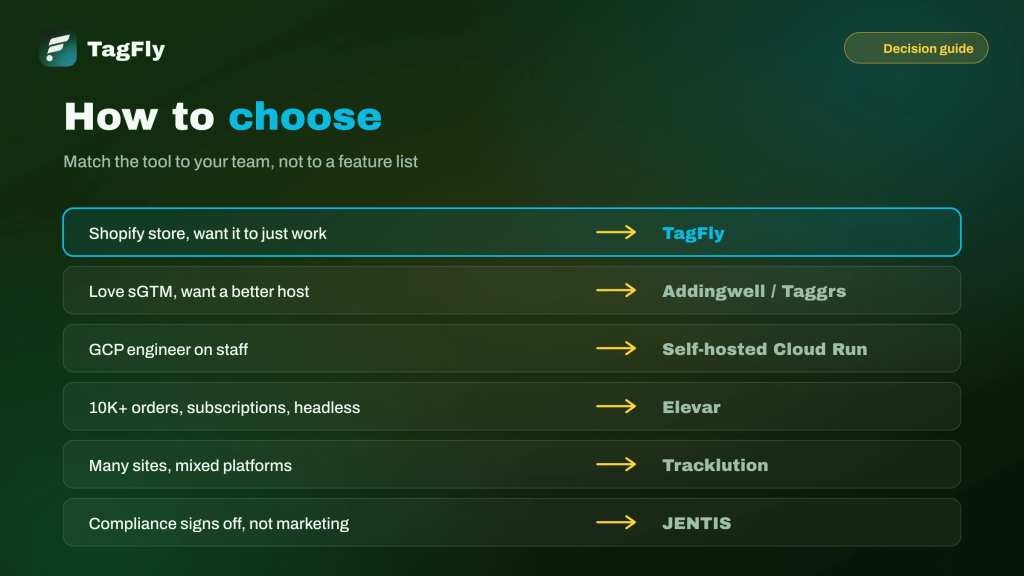
- You run Shopify and want tracking to just work: TagFly. Prebuilt container, nine destinations, and a bill driven by orders you can forecast rather than requests you cannot.
- You love sGTM and want a better host: Addingwell for EU residency and tooling, Taggrs for the cheapest direct swap.
- You have a GCP engineer with spare capacity: self-host on Cloud Run, but budget the engineering hours honestly.
- You do 10,000+ orders a month with subscriptions or headless: Elevar, and treat the destination caps as part of the price.
- You run many sites on mixed platforms: Tracklution or Taggrs, depending on whether you want managed or DIY.
- Compliance signs off on your stack, not marketing: JENTIS.
- Your real problem is scattered customer data: Segment. It is not a Stape replacement, it is a different layer.
How to migrate off Stape without losing conversion data
The single biggest migration risk is double-counting: running the old container and the new solution against the same pixel at once, which inflates conversions and poisons your ad platform’s optimisation for weeks. Work through these steps in order.
- Baseline first. Record 14 days of purchase counts in GA4, Google Ads, and Meta before you change anything. Without a baseline you cannot tell whether the new setup improved or broke your tracking.
- Create a parallel test property. Set up a fresh GA4 property or a developer-mode pixel for the new tool. Never point both systems at the same production pixel during overlap.
- Install the replacement and connect one destination. Start with GA4, the easiest to validate. Confirm events arrive in the new tool’s real-time dashboard.
- Validate event by event. Walk a full purchase path yourself: view item, add to cart, begin checkout, purchase. Our guide on how to check Google Tag Manager is working covers the debug steps.
- Add remaining destinations one at a time. Meta CAPI is where deduplication matters most. If you are configuring it manually, our GTM Facebook Conversions API walkthrough shows what the event ID matching needs to look like.
- Disable the old container, then cancel. Turn off tracking in Stape before you cancel the subscription, and watch your numbers for a full week. Cancel only once the new numbers hold steady against your baseline.
👉 Do not migrate during a sale period, a product launch, or the two weeks before Black Friday. Attribution noise during a spike makes it impossible to tell a migration bug from a demand surge.
Frequently asked questions about Stape alternatives
Is there a free Stape alternative?
Yes. TagFly has a free lifetime plan covering one destination and 10 orders per month with server-side tracking, Taggrs is free up to 10,000 requests per month, and Addingwell offers a free sandbox. Stape’s own free tier covers 10,000 requests. For a small Shopify store, TagFly’s free plan is the only one that includes a prebuilt container rather than an empty one.
Do I still need Google Tag Manager if I leave Stape?
Not necessarily. Managed sGTM hosts like Addingwell and Taggrs are built entirely on GTM, so you keep it. Shopify apps such as TagFly ship a prebuilt GTM container that you never have to configure, and platforms like Tracklution or JENTIS replace GTM outright with their own tag layer. Choose based on whether you want GTM’s flexibility or want to stop touching it.
Why is my Stape bill higher than I expected?
Because Stape bills incoming requests, not orders or GA4 events, and requests include script loads like gtm.js, bot traffic, and your own preview sessions. One event fanning out to six destinations still counts as one request, but a crawler hammering your container domain counts every hit. Flat-priced alternatives remove this variable entirely.
Is Stape or TagFly better for a Shopify store?
TagFly is better for most Shopify merchants because it includes the prebuilt container, the server-side connections, and support from $14.99 per month, and it meters orders rather than server requests. Stape is better if you need a fully custom container, non-standard server logic, or you run several non-Shopify platforms and want one hosting vendor across all of them.
Will switching off Stape hurt my Google Ads or Meta performance?
Only if you double-track or leave a gap. Run the new solution against a test property first, validate every event, then disable Stape tracking before cancelling. Handled that way, conversion volume typically holds steady or improves, since managed tools apply event deduplication and Consent Mode v2 by default.
Which Stape alternative is best for agencies managing many stores?
Taggrs and Addingwell both offer APIs and multi-container management for agencies staying on sGTM, while Tracklution is built around multi-client workflows. If your clients are all on Shopify, per-store app installs are usually cheaper and faster than provisioning a container and subscription per site.
The bottom line on Stape alternatives
Stape is a good product solving a narrow problem: getting an sGTM container hosted cheaply. The question worth asking is whether hosting was ever your actual bottleneck. For most Shopify merchants it was not. The bottleneck was building and maintaining the container, and no hosting vendor removes that. If you want maximum control, self-host or move to Addingwell. If you want enterprise ecommerce depth and have the volume to justify it, look at Elevar. If you want accurate conversion data flowing to nine destinations on a bill that tracks your orders instead of your bot traffic, install TagFly and start on the free plan before you cancel anything.
New to the underlying concepts? Start with our primer on Google Tag Manager for beginners, then read the server-side tracking guide to understand what you are actually buying.