If you are weighing TagFly vs Triple Whale, you are probably trying to answer one question: can a marketing attribution platform like Triple Whale replace a dedicated Shopify conversion tracking app, or do you need both? The short version is that they solve two different problems. One sends clean, server-side conversion data into your ad platforms so they can optimize. The other reads data out to tell you which channel earned the sale. Confusing the two is how stores quietly starve their ad accounts of the signal that drives performance.
Quick answer: Triple Whale cannot replace a conversion tracking app like TagFly. TagFly is the data pipeline that feeds accurate first-party, server-side events to Google Ads, GA4, Meta, TikTok, and 5 more destinations for ad optimization. Triple Whale is an attribution and analytics layer that reads and reports on that data. Run both: TagFly feeds the signal, Triple Whale interprets it.
What you’ll learn in this article:
- The real difference between a tracking app and an attribution platform
- What TagFly does and what Triple Whale does
- A side-by-side feature and destination comparison
- Why Triple Whale cannot replace your conversion tracking
- How TagFly and Triple Whale work better together
- Multi-market tracking: TagFly’s edge for cross-border stores
- Pricing for both, and how to choose
TagFly vs Triple Whale: what is the real difference?
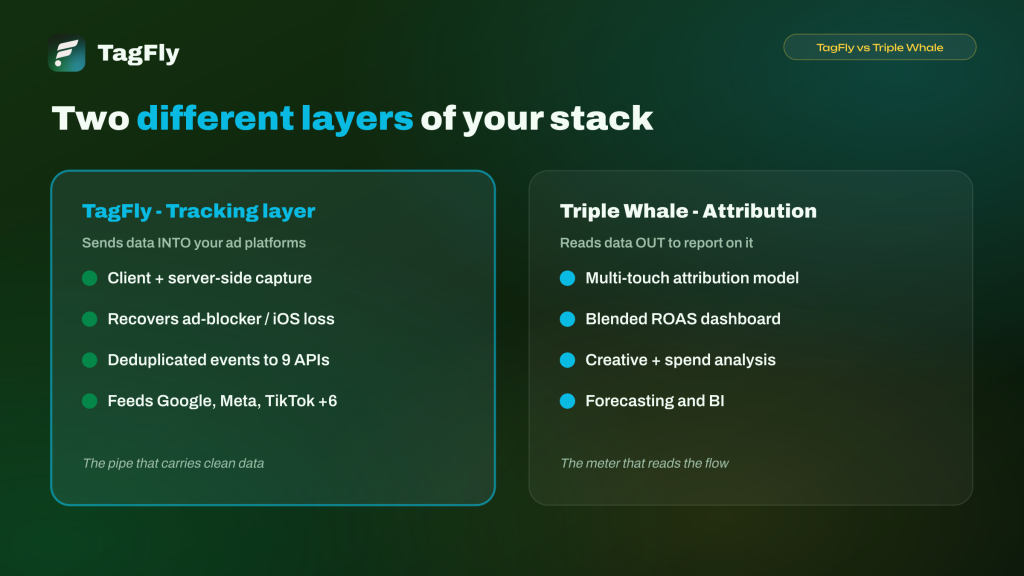
The core difference is direction of data. TagFly is a conversion tracking app – it pushes accurate purchase and funnel events out to your advertising and analytics destinations so those platforms can attribute, learn, and bid. Triple Whale is a marketing attribution and business-intelligence platform – it pulls data in from your store and ad accounts to model which touchpoints drove revenue and to visualize it on a dashboard.
They live on different layers of your stack. Think of TagFly as the plumbing that carries clean water, and Triple Whale as the meter that tells you how much water flowed and where it came from. A meter is useless if the pipe is leaking, and that is exactly what happens when merchants assume the Triple Pixel replaces server-side tracking to their ad platforms.
- Tracking layer (TagFly): collects first-party events client-side and server-side, then delivers them to Google Ads, GA4, Meta Conversions API, TikTok Events API, and more for optimization.
- Attribution layer (Triple Whale): ingests data to build multi-touch attribution, blended ROAS, and reporting for decision-making.
What is TagFly?
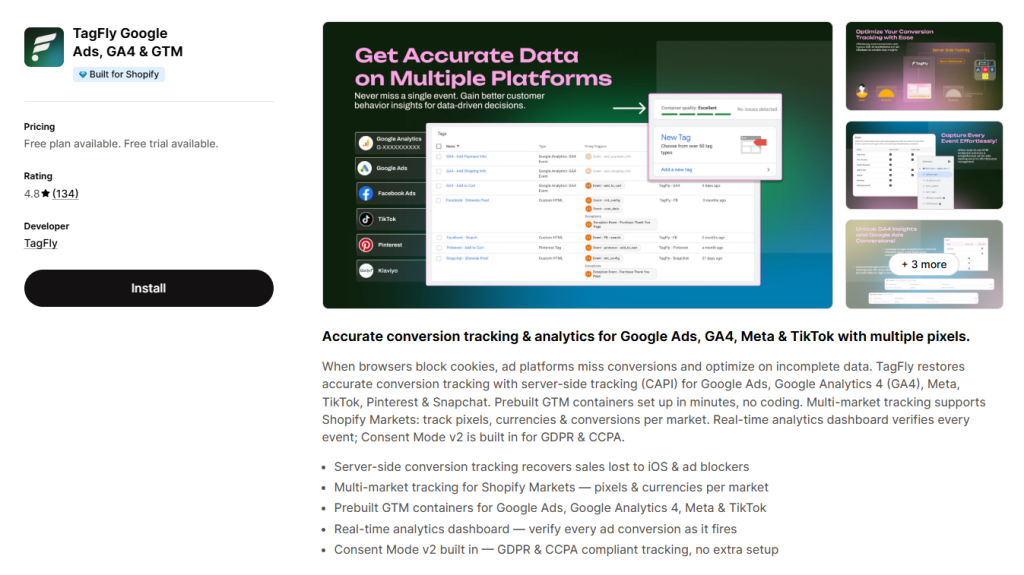
TagFly is a Shopify app that installs a prebuilt Google Tag Manager container plus native server-side tracking, then sends 100% first-party event data to 9 destinations. It exists to recover the conversions that browser-side pixels lose to ad blockers, iOS restrictions, and Safari’s Intelligent Tracking Prevention, so your ad platforms optimize on complete data instead of a partial picture.
Because the server-side layer is native, you do not have to host or pay for a separate Stape or Google Cloud server. Setup is no-code and takes about 5 minutes. If you are new to the underlying technology, our server-side tracking guide walks through how the client-side and server-side pieces fit together on Shopify.
- 9 destinations: GA4, Google Ads, Meta (CAPI), TikTok, Pinterest, Snapchat, X (Twitter), Klaviyo, and Microsoft Ads.
- Native server-side: no Stape or Google Cloud hosting to manage.
- Built-in accuracy features: Consent Mode v2, event deduplication, a real-time dashboard, an event builder, and multi-market tracking.
💡 If your priority is getting Meta to optimize on clean purchase data, see how the server-side connection is built in our GTM Facebook Conversions API guide.
What is Triple Whale?
Triple Whale is a marketing attribution and analytics platform – it calls itself an “Attribution OS” – built around its proprietary Triple Pixel. The Triple Pixel is a first-party identity graph that stitches sessions to orders so Triple Whale can attribute revenue across Meta, Google, TikTok, and other channels, then present it in a unified dashboard with blended ROAS, creative analysis, and forecasting.
That identity resolution is genuinely useful for measurement. According to Triple Whale, the pixel uses first-party data and server-side technology to bridge gaps created by Apple’s privacy changes when attributing ad clicks to conversions, per its own Triple Pixel documentation. But attributing a conversion after the fact is a different job from continuously feeding conversion events into each ad platform’s API so the platform’s algorithm can optimize bids in real time.
TagFly vs Triple Whale: side-by-side comparison
Here is how the two tools line up across the jobs a Shopify store actually needs done. Notice that most rows are not “better or worse” – they are simply different responsibilities.
| Capability | TagFly | Triple Whale |
|---|---|---|
| Primary job | Send accurate conversion data to ad platforms | Attribute revenue and report on it |
| Server-side to ad-platform APIs | Yes – native CAPI/Events API to 9 destinations | Not its purpose – focuses on its own pixel and reporting |
| Destinations covered | GA4, Google Ads, Meta, TikTok, Pinterest, Snapchat, X, Klaviyo, Microsoft Ads | GA4, Google Ads, Meta, TikTok, Pinterest (partial), Klaviyo |
| Prebuilt GTM + Consent Mode v2 | Yes | No |
| Multi-market tracking (per-market pixel routing) | Yes – route each Shopify Market to its own pixel per channel | No – reports on markets, does not route server-side events per market |
| Multi-touch attribution + BI dashboard | Basic real-time dashboard and Customer Analytics | Yes – this is its core strength |
| Starting price | Free, then $14.99/mo | Paid plans from roughly $149/mo |
Can Triple Whale replace a conversion tracking app?
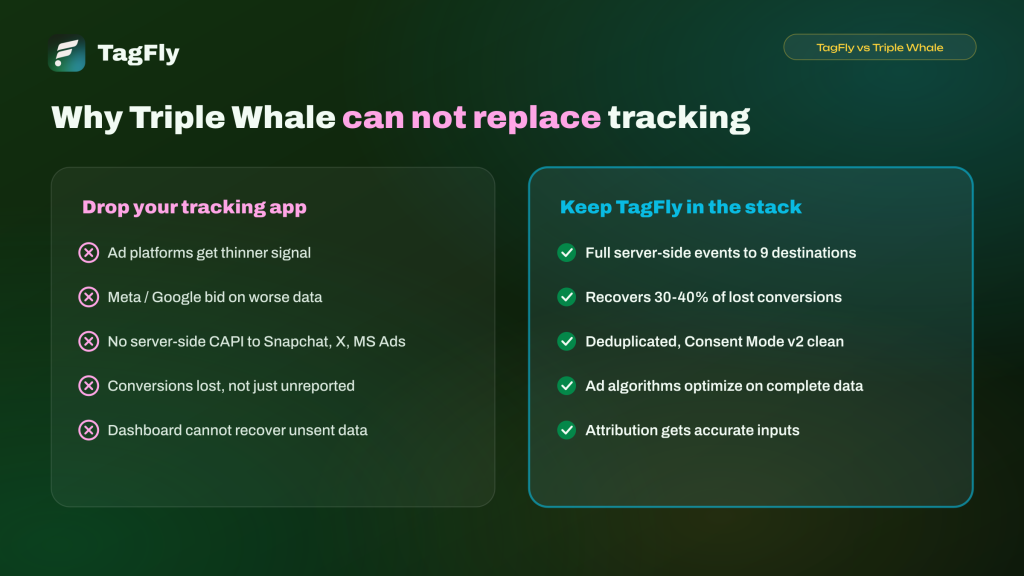
No – Triple Whale cannot replace a dedicated conversion tracking app, and treating it that way usually hurts ad performance. The Triple Pixel is optimized to feed Triple Whale’s own attribution engine, not to maintain a complete, deduplicated server-side event stream into every ad platform’s Conversions API. If you uninstall your tracking app because “Triple Whale already has a pixel,” the platforms doing your bidding – Meta, Google, TikTok – can end up with thinner conversion signal than before.
⚠ Ad platforms optimize on the events you send them. If Meta’s Conversions API or Google’s Enhanced Conversions receive fewer, lower-quality events, the algorithm bids on worse data – no dashboard can fix that after the fact.
There is also a coverage gap. Triple Whale concentrates on the big paid-social and search channels it attributes, so destinations like Snapchat, X (Twitter), and Microsoft Ads are not part of its server-side conversion delivery. TagFly sends server-side events to all 9. Even Meta itself recommends pairing the Pixel with the Conversions API for durable measurement, as Triple Whale notes in its own Meta attribution guide – and maintaining that CAPI connection cleanly is exactly a tracking app’s job.
In TagFly’s benchmarks across 200+ Shopify stores, a properly configured client-side plus server-side setup recovers 30-40% of conversions that browser-only pixels lose to ad blockers and iOS. That recovered signal flows to your ad platforms for optimization – a reporting tool sitting on top of leaky tracking never sees those conversions at all.
Why TagFly and Triple Whale work better together
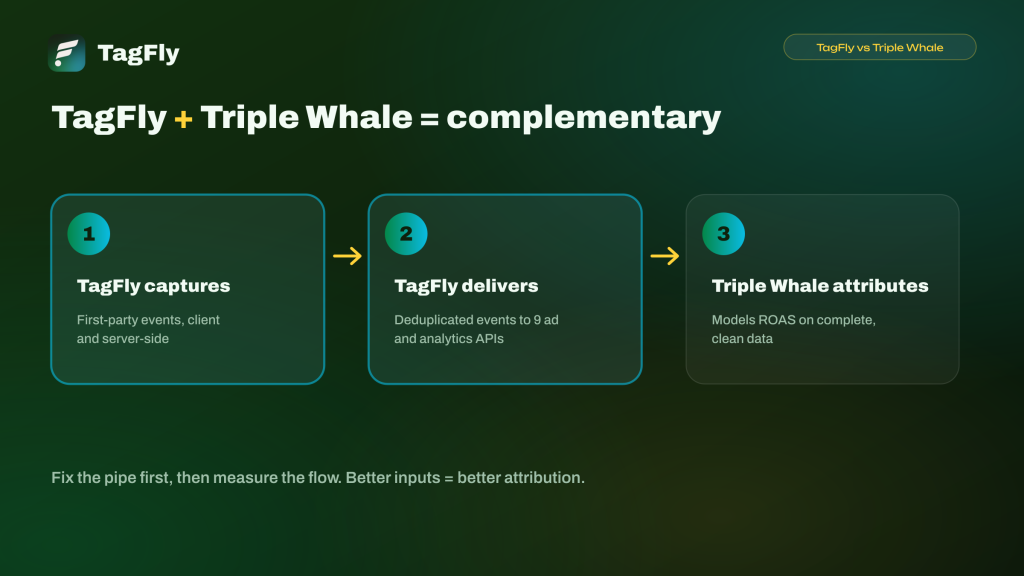
The winning setup is not “one or the other” – it is TagFly and Triple Whale as complementary layers. TagFly guarantees the ad platforms and GA4 receive complete, first-party, deduplicated conversion data. Triple Whale then sits on top of a clean data foundation and attributes it accurately. Better inputs make Triple Whale’s attribution more trustworthy, and better ad-platform signal makes your campaigns cheaper to scale.
- Step 1 – TagFly captures: first-party events collected client-side and server-side, recovering conversions lost to blockers and ITP.
- Step 2 – TagFly delivers: deduplicated events sent to Google Ads, GA4, Meta CAPI, TikTok, and the rest for real-time optimization.
- Step 3 – Triple Whale attributes: reads the richer data set to model multi-touch ROAS and guide budget decisions.
👉 Install TagFly first to fix the pipe, then let Triple Whale measure the flow. Fixing attribution before fixing tracking is optimizing a report built on missing data.
Multi-market tracking: where TagFly pulls ahead for Triple Whale stores
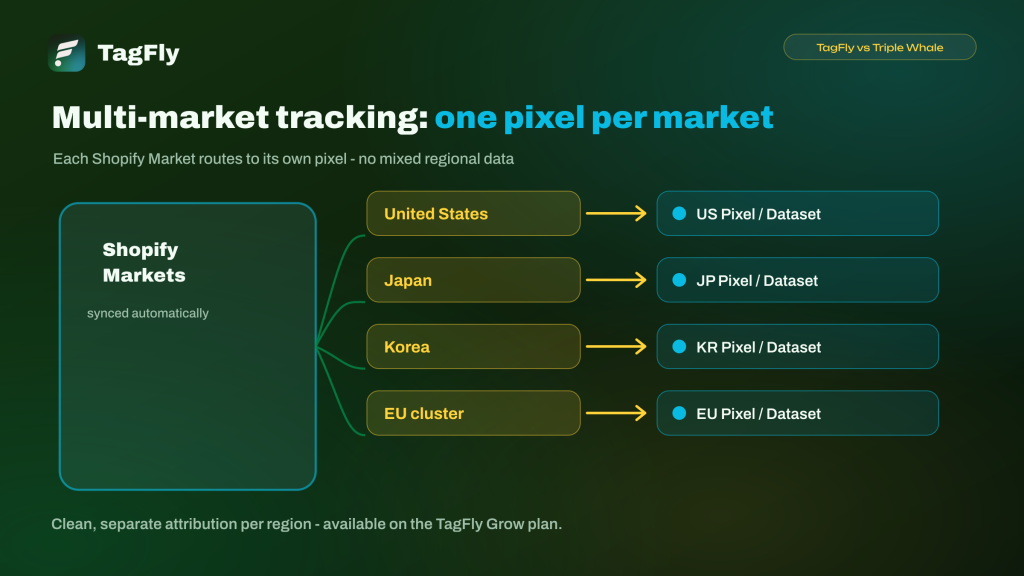
Multi-market tracking is TagFly’s strongest edge for the exact merchants who buy Triple Whale. Triple Whale’s customers are stores spending seriously on ads, and a large share of them sell across borders through Shopify Markets and multiple currencies. Those stores hit the classic cross-border tracking problem: every market’s events land in the same pixel, so Japanese, Korean, and US data blend into one account and no regional ad manager gets clean numbers. TagFly’s multi-market tracking fixes this at the pipeline level – and it is a job attribution reporting alone cannot do.
With multi-market tracking on, you assign each pixel of a channel to one or more Shopify Markets, and TagFly routes events from a market only to that market’s pixel or dataset. Japanese orders go to your Japanese dataset, Korean orders to the Korean one, and nothing gets mixed – clean, separate attribution per region, managed from one place. Markets sync automatically from Shopify Markets, per the official multi-market tracking guide.
- Per-market pixel routing: supported on Facebook, GA4, Google Ads, TikTok, Pinterest, and Snapchat – each channel configured independently.
- No duplicated data: each market belongs to exactly one pixel per channel, so the same event is never counted twice across regional ad accounts.
- Coverage warnings: TagFly flags any market not yet assigned to a pixel, so you do not silently lose a region’s events.
- Built for how you sell: one ad account per region, regional agencies, or market clusters like grouping your EU countries onto one shared pixel.
This is the difference between measuring and optimizing again. Triple Whale can report revenue by market, but it does not route your server-side conversion events to a separate pixel per region so each regional ad account optimizes on its own clean data. TagFly does – which is why multi-market Shopify stores running Triple Whale still need TagFly underneath. Multi-market tracking is available on TagFly’s Grow plan and works alongside our Shopify GTM setup.
Pricing: TagFly vs Triple Whale
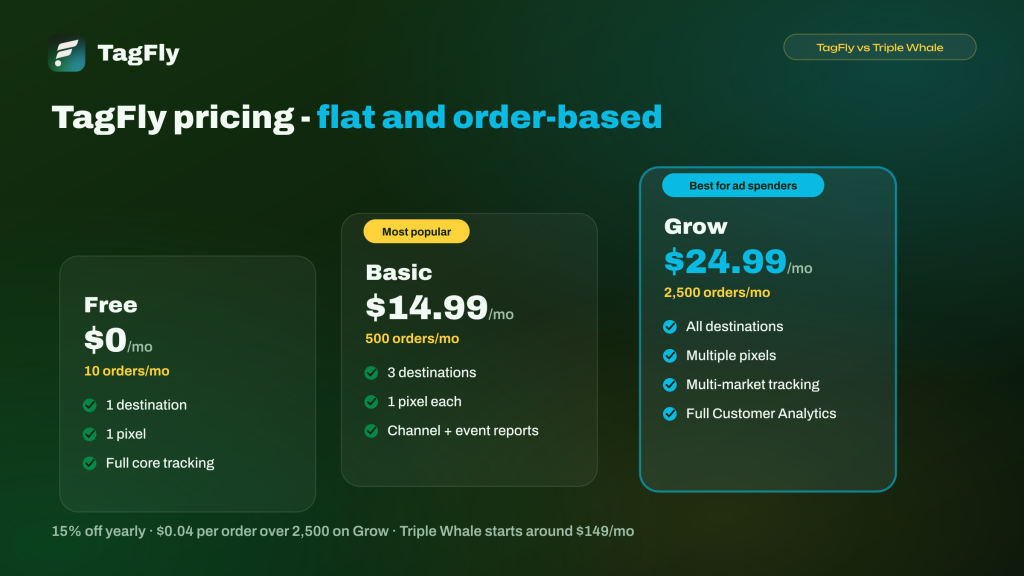
Pricing is where the two tools separate most clearly, because they are built for different budgets and jobs. TagFly is priced at a Shopify-app level with order-based plans. Triple Whale is priced as an enterprise-leaning analytics platform.
| Plan level | TagFly | Triple Whale |
|---|---|---|
| Free | $0/mo – 10 orders/mo, 1 destination, 1 pixel, full core tracking | Limited free tier / trial |
| Entry paid | Basic $14.99/mo – 500 orders/mo, 3 destinations, 1 pixel each | From about $149/mo (Starter) |
| Higher tier | Grow $24.99/mo – 2,500 orders/mo ($0.04/order over), all destinations, multiple pixels, multi-market tracking, full Customer Analytics | $219-$449/mo and up, by revenue/ad spend |
| Pricing model | Order-based plans – 15% off yearly | Tiered by store size and spend |
Triple Whale’s plans start around $149/mo and scale into the hundreds per month depending on billing terms and store size, per third-party pricing reviews such as G2’s Triple Whale pricing listing. Always confirm current numbers on the official Triple Whale pricing page and the TagFly pricing page, since both change. The practical takeaway: adding TagFly to a Triple Whale stack is a small monthly cost that protects the data quality Triple Whale depends on – and unlocks multi-market routing that Triple Whale does not do.
How to choose between TagFly and Triple Whale
Choose based on the problem you have, not the label on the tool. If your ad platforms are optimizing on incomplete data, or you have no reliable server-side tracking, start with TagFly. If you have clean tracking but cannot see which channels truly drive revenue, add Triple Whale. Most scaling stores end up needing both, in that order.
- Pick TagFly if: you want accurate server-side conversions in Google, Meta, TikTok, and 6 more destinations without hosting a server, at a flat price – and per-market routing if you sell cross-border.
- Pick Triple Whale if: you want a multi-touch attribution dashboard and are ready for an analytics-platform budget.
- Run both if: you are spending seriously on ads and want trustworthy attribution built on complete tracking data.
Frequently asked questions
Is Triple Whale a conversion tracking app?
Not primarily. Triple Whale is a marketing attribution and analytics platform whose Triple Pixel resolves identity to model which channels drove revenue. It reads and reports on data rather than maintaining a complete server-side conversion feed into each ad platform’s API, which is the job of a dedicated tracking app like TagFly.
Do I need TagFly if I already use Triple Whale?
Yes, in most cases. Triple Whale attributes conversions but does not replace server-side tracking into Google, Meta, TikTok, and other ad platforms for optimization. TagFly delivers that clean, deduplicated data to 9 destinations, which also makes Triple Whale’s attribution more accurate. The two are complementary layers, not substitutes.
Does Triple Whale support multi-market or multi-currency tracking?
Triple Whale can report revenue by market, but it does not route your server-side conversion events to a separate pixel per Shopify Market for ad optimization. TagFly’s multi-market tracking does exactly that – assigning each market to its own pixel per channel – so cross-border stores get clean, separate attribution and each regional ad account optimizes on its own data.
Will using both TagFly and Triple Whale cause double counting?
No, when set up correctly. TagFly handles event deduplication and Consent Mode v2 so your ad platforms receive one clean event per conversion. Triple Whale attributes separately using its own pixel and models. They operate on different layers, so running both does not inflate your ad-platform conversion counts.
Which is cheaper, TagFly or Triple Whale?
TagFly is significantly cheaper, starting free and then $14.99/mo, because it is a focused Shopify tracking app. Triple Whale’s paid plans start around $149/mo and scale up, since it is a full attribution and BI platform. They are priced for different jobs, so the useful comparison is value per job, not price alone.
Can TagFly do attribution reporting like Triple Whale?
TagFly includes a real-time dashboard and Customer Analytics for segment-level insight, but it does not aim to replace a dedicated multi-touch attribution platform. If you need blended ROAS, creative analysis, and forecasting, Triple Whale is stronger there – fed by the clean tracking data TagFly provides.
Conclusion: feed the signal, then measure it
TagFly vs Triple Whale is not really a versus at all. Triple Whale is an excellent attribution and analytics platform, but it cannot replace the server-side conversion tracking that keeps your ad platforms optimizing on complete data – and for cross-border stores, it cannot route each market to its own pixel the way TagFly’s multi-market tracking does. TagFly fills both roles at a flat, predictable price and delivers first-party events to 9 destinations, which in turn makes Triple Whale’s attribution more accurate. Fix the tracking first, then let attribution do its job.
💡 Ready to give your ad platforms and your attribution tool clean data to work with? Start with TagFly – free to install, 5-minute setup, 9 destinations, multi-market ready.
|
Triple Whale measures it. TagFly makes sure it’s there to measure. Clean server-side data to 9 destinations, plus per-market tracking. Free to install. |